 Ormond Beach Golf Cart Repair
Golf Cart Battery Replacement in Ormond Beach
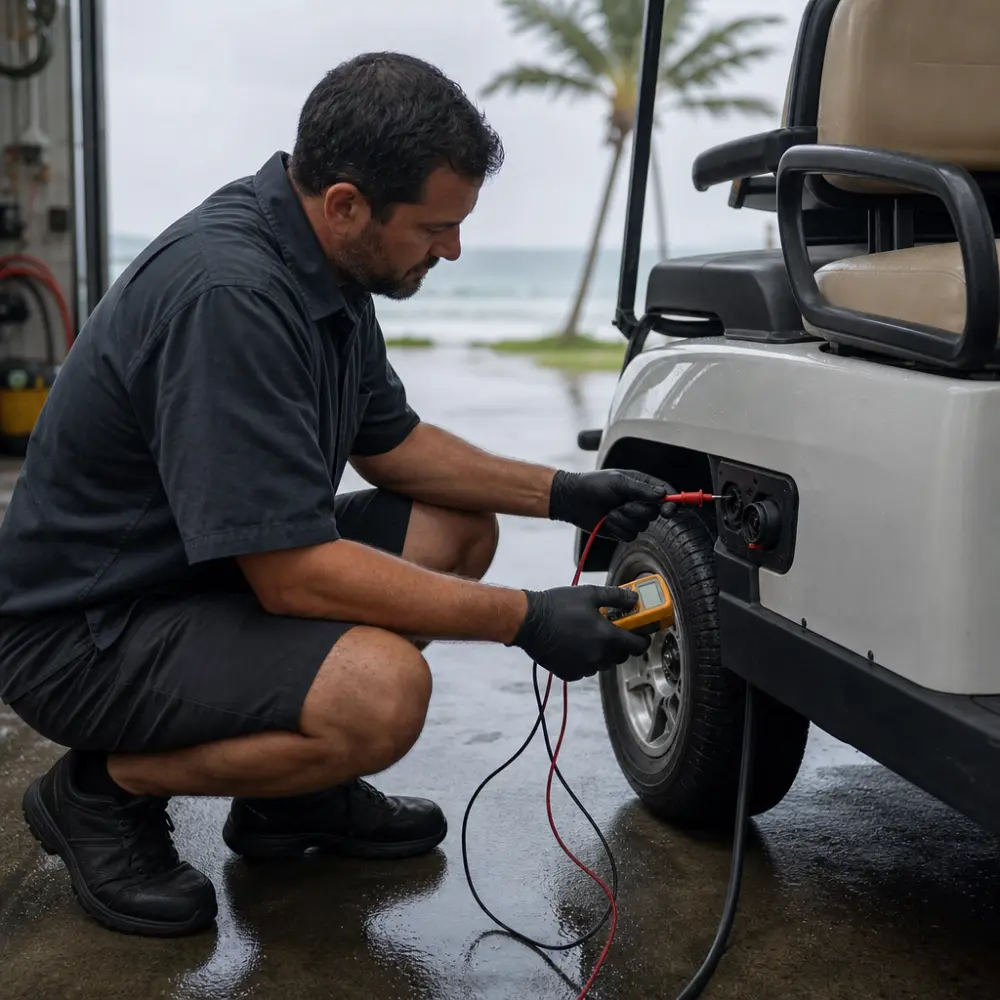
Full battery packs are swapped at your home for $1,200 to $1,800 for lead-acid (36V packs from about $1,200, 48V packs up to roughly $1,800 with premium brands) including terminal service, watering, and haul-away of the old cores. Lithium conversions run $1,600 to $3,500 installed. Usually one visit once the batteries are on hand, anywhere in Ormond Beach, Ormond-by-the-Sea, Daytona Beach, Port Orange, Palm Coast, and Holly Hill.
Why Atlantic coast packs die early
Lead-acid golf cart batteries last roughly 4 to 6 years under classic northern golf-course duty: a summer of rounds, a winter in a cold barn. Ormond Beach carts get none of that. Three things shorten the clock.
Heat. Florida summers here are long and hot, with an August mean temperature of 83.1, and the air inside a closed garage or under a black seat runs hotter than that. A Department of Energy technical report on sealed lead-acid batteries states the industry rule: every 15 degree Fahrenheit rise in operating temperature cuts battery life roughly in half. Trojan Battery’s guidance adds that elevated temperatures raise capacity briefly “at the cost of battery life” and increase self-discharge. Heat also boils water out of flooded cells; let the electrolyte drop below the plate tops and, in Trojan’s words, the damage is irreparable.
No layup. Carts here run errands in January the same as June. A pack absorbs more discharge cycles per calendar year than the same pack inland, and cycle count is what kills lead-acid. An Ormond-by-the-Sea cart doing daily errand runs can put two northern years of cycling on its pack in one.
Salt and humidity. Carts on the beachside, in Ormond-by-the-Sea, and up in Palm Coast live within a short distance of open Atlantic water, and the Halifax River, the Tomoka River, and the Intracoastal carry salt air inland. Corrosion at terminals and lugs adds resistance, resistance makes every charge cycle less complete, and a lead-acid battery held below full charge sulfates. Sulfated plates permanently lose capacity. That chain is written up in what kills golf cart batteries in Ormond Beach.
When the cart sits through a seasonal owner’s summer, self-discharge in a 90-degree garage finishes the job; a tune-up on return in October often saves the pack.
The symptoms, in the order owners notice them
- Shrinking range. The loop to the clubhouse and back that used to leave half a charge now runs the meter low.
- Longer charging. The charger runs hours past its old finish time, or never quite clicks off.
- Sag on the grade. The cart noticeably slows on the bridge over the Intracoastal, the hill out of a parking garage, or the rise onto a community’s entrance.
- The hard stop. One battery finally quits, and a series pack is only as strong as its weakest battery.
Important: these symptoms overlap with charger and cable problems. A failing charger starves a healthy pack and mimics battery death; a corroded main cable does the same. Before we quote any pack, we load-test each battery individually, check specific gravity with a hydrometer on flooded packs (Trojan’s full-charge reference is 1.277 or higher at 80 degrees), run a voltage-drop test along the main cables, and test the charger’s actual output. If the fix is a $300 charger instead of a $1,200 pack, that is what we will tell you. Sometimes the load test shows one or two failed batteries dragging down four good ones: on a young pack, replacing just those is right. On an old pack it is not, because new batteries in series with tired ones get pulled down to the old pack’s level fast, so ask us plainly which situation you are in.
Lead-acid vs AGM vs lithium: the actual choices
| Flooded lead-acid | Sealed AGM | Lithium (LiFePO4) | |
|---|---|---|---|
| Installed cost | $1,200 to $1,800 | Above flooded, below lithium | $1,600 to $3,500 |
| Typical life | 4 to 6 years | Similar, less abuse-tolerant | 7 to 10-plus years |
| Watering | Monthly, more in summer | None | None |
| Heat and humidity exposure | Vented, terminals suffer most | Sealed case helps | Sealed, minimal |
| Charging | Overnight | Overnight | A few hours |
| Weight | 350-plus lbs | Similar | Roughly a third |
| Power delivery | Sags as it discharges | Sags less | Steady until nearly empty |
Flooded is the value default. Trojan T-105s (6V) and T-875s (8V) are the benchmark for a reason, but flooded packs demand the watering schedule and terminal care that Florida heat punishes you for skipping. AGM buys freedom from watering and a sealed case that handles humidity better, at a premium that makes sense for owners who know they will not maintain flooded batteries. LiFePO4 wins the ten-year math for true daily drivers: one purchase instead of two, zero maintenance, faster turnaround between errand runs, steady speed all the way down, and a conversion includes the correct lithium-specific charger, since a lead-acid charger profile will not properly charge lithium.
The deciding variable is usage. Daily driver in Plantation Bay, Halifax Plantation, or on the Ormond beachside: lithium usually pencils out. Seasonal cart that sits from April to October, or a weekend runabout: quality flooded lead-acid usually wins. The arithmetic is written out in lithium conversion for an Ormond Beach cart: what it costs and when it pays, and every option is on the pricing page.
What the install includes
Every pack replacement gets the same finish: cables inspected and replaced if corroded, terminals cleaned and coated against salt air, hold-downs torqued, a full watering on flooded packs, a test drive, and the old cores hauled away for recycling at no charge. All in your driveway or cart barn, with the service call usually applied toward the job.
Get a battery quote
Tell us the cart brand and the battery count (six 6-volts is 36V, six 8-volts or four 12-volts is 48V) plus a photo of the battery compartment. That lets us give you a flat installed price and an install slot, anywhere in Ormond Beach, Ormond-by-the-Sea, Daytona Beach, Port Orange, Palm Coast, or Holly Hill.
Frequently Asked Questions
How much is a full battery pack installed?
Lead-acid packs run $1,200 to $1,800 installed for most carts: 36V six-battery packs from about $1,200 to $1,600, 48V packs from $1,400 to about $1,800 with premium brands like Trojan. That includes installation, cable and terminal service with anti-corrosion coating, a full watering, and haul-away of the old cores.
How do I know the pack is actually done?
Range keeps shrinking, the charger runs longer than it used to or never clicks off, and the cart sags on the bridge or the hill out of the garage. A load test on each battery confirms it. Often one or two bad batteries are dragging down the rest, and on a young pack that is all you replace.
How long will a new pack last in Ormond Beach?
Lead-acid runs roughly 4 to 6 years, and Atlantic coast daily drivers trend toward the short end. Heat drives water out of the cells and speeds self-discharge, there is no winter layup so packs cycle year-round, and salt air adds resistance at the terminals. Monthly watering, clean coated terminals, and full recharges after use push you toward the long end.
Is lithium worth it here?
For a daily driver in Ormond-by-the-Sea or on the Ormond beachside, often yes: 7 to 10-plus year life, zero watering, faster charging, a sealed case that shrugs off humidity, at $1,600 to $3,500 installed. For a seasonal or lightly used cart, quality lead-acid usually wins the math. Do the math on your actual usage before you choose.
What happens to my old batteries?
The installer should haul them away. Lead-acid cores have real recycling value, so ask for removal to be included with no disposal fee; nobody should leave 60-pound batteries sitting in your garage.